Groundwork: Get a free quote • Fast response
Groundwork
Do you need help with groundwork? Whether it’s for your house, garage or garden, groundwork can be a demanding and extensive job. Errors in groundwork can have major consequences for the rest of the project. That’s why it’s important to choose a skilled and experienced excavation contractor who can provide a solid foundation.
Here we give you an overview of different types of groundwork, what it costs and what you should consider before getting started. We can also provide you with a free, no-obligation quote from a qualified excavation contractor in your area.
Get a free quote for groundwork
Send us a short description of your wishes and needs, and we’ll help you find the best suited excavation contractor for your particular job.
Your contact information will only be used in connection with the request. Your personal data will not be disclosed to unauthorized persons.
What is groundwork?
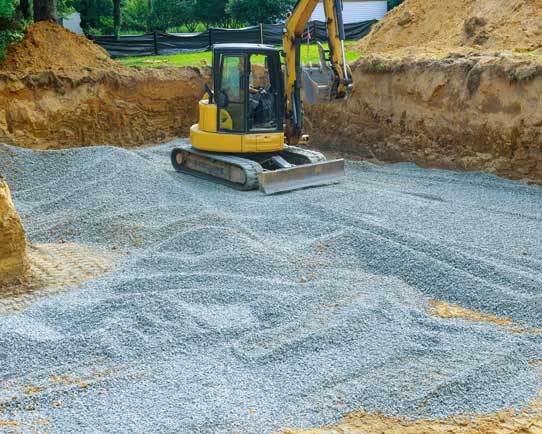
Groundwork is all the work that is done to prepare the ground before starting the actual construction or erection of a structure. It often includes excavation, grading, drainage, foundations and other necessary measures to ensure a stable and dry surface.
Well-executed groundwork is crucial for avoiding subsidence damage, moisture problems and other challenges in the long term. Whether you’re building a house, garage, retaining wall or landscaping a garden, groundwork should be prioritized and carried out by professionals with the right skills and equipment. Thorough planning and good communication with the contractor along the way are important for a successful result.
How much does groundwork cost?
The price of groundwork varies widely depending on the scope and complexity of the project. As a rule of thumb, you can expect to pay between NOK 3,000 – 12,000 per square meter for groundwork, but there are wide variations.
The reason for the large price differences lies in the tasks involved. Some sites require extensive excavation and removal of soil, while others mainly require grading. Drainage and insulation against the ground are also included. Difficult ground conditions with poor soil, rock or the need for blasting naturally result in a much higher price per square meter than a simple, flat plot.
For a residential plot of 150 square meters, for example, you could end up with a total price of anything from NOK 450,000 to NOK 1.8 million for the groundwork, depending on the conditions. In order to get a more accurate price, you should obtain quotes based on an assessment of the plot in question. It pays to get this early in the process so that you can adjust your budget and expectations to the actual costs.
Garage groundwork price
The average price for groundwork for a garage is around NOK 150,000, including all materials and labor. The price can of course vary depending on the ground conditions and size of the garage.
Most people end up paying between NOK 50,000 and 300,000 for the groundwork. The exact price will only be known once the contractor has visited the site and provided a specific quote.
Price of paving with groundwork
Good groundwork is crucial for a successful asphalt project. Paving usually costs between NOK 300-600/m2 in addition to the groundwork. The price is affected by the need for levelling, the desired thickness and quality of the asphalt.
If you need to pave 100 m2 with 4.5 cm thickness and moderate quality, the price usually ends up between NOK 30,000 and 60,000. The larger the area to be paved, the better the price per square meter.
Groundwork plot price
The price of groundwork for a plot depends on the size of the plot, terrain, ground conditions and accessibility on the plot. For all groundwork, you should expect to pay between NOK 3,000 and 12,000 per square meter.
If we’re talking exclusively about excavation and site preparation, the cost will usually be somewhere between NOK 1,500 and 5,000 per square meter. Complicated terrain with a lot of rock or the need for blasting can result in a much higher price.
What affects the price of groundwork?
-
The nature of the site and ground conditions: Mountains, bogs and other difficult soils require more work.
-
Access and accessibility: Difficult access increases time and cost.
- Need for blasting, rock piling or sheet piling.
-
Weather conditions: Heavy rainfall often causes delays and challenges in groundwork.
-
The scope of the excavation work and the amount of material to be moved.
- Delivery time and complexity of the project.
-
The need for mass replacement and new fill materials such as crushed stone, gravel and shingle.
- Requirements for insulation and drainage.
- Choice of contractor and local market prices.
Different types of groundwork
Groundwork is carried out in connection with the construction and erection of a number of different structures. Some main categories are:
Groundwork for houses
Groundwork for houses involves excavating a basement or foundation/ring wall, laying drainage and insulation. As a rule, mass is also backfilled around the foundation wall. Good planning is important in order to adjust the height of the foundation and avoid problems with water.
Garage groundwork
For garage groundwork, vegetation and soil are removed before filling with crushed stone and formwork for the base. For garages with a concrete floor, insulate it against the ground. Good drainage around the garage is also important to avoid moisture.
Lawn groundwork
For lawn groundwork, the top layer of soil is often removed before a new layer of quality soil or growing media is added. Correct slope, a minimum of 10 cm thickness of the growth layer and good drainage are important for a nice, even and durable lawn.
Asphalt groundwork
For asphalt groundwork, the substrate must be well compacted and a non-woven fabric, crushed stone base layer and leveling with finer gravel must be laid. Well-executed groundwork with the right depths and compaction of masses is important to avoid frost heave and settlements in the asphalt.
Groundwork for retaining walls
Groundwork for retaining walls involves excavation to a frost-free depth and foundation for the wall. For concrete walls, the base and wall are usually cast in one piece. In the case of dry walls, crushed stones are filled behind the wall for drainage. Slope and drainage away from the wall are important.
Groundwork for a terrace
When establishing a terrace, first excavate to the desired depth for the base layer. Non-woven fabric, crushed stone and finer materials are compacted well before leveling. A stable and well-drained surface is required for paving stones, wood or concrete decking.
Groundwork for decking
For wooden decking, it is important to have good foundations for load-bearing posts. Excavation is required for the placement of post shoes or concrete foundations. The correct slope for drainage and frost protection is also key.
Site groundwork
Site preparation and grading often involves removing stumps, roots and topsoil before filling and compacting the soil to the right height. Foundations for homes, garages and any retaining walls are excavated. Trenches for water, sewage and drainage are established.
Greenhouse groundwork
When carrying out groundwork for greenhouses, it is important to have a level and stable surface. Vegetation and topsoil are removed before stone or crushed stone is compacted, possibly in combination with a concrete cover or slab. Drainage and construction are dimensioned for snow loads in winter.
Casting sole groundwork
Groundwork for sole involves excavation at a frost-free depth, min. 0.9 m below the finished floor. The surface is compacted before pouring concrete, approx. 25 cm thick. When thawing from frost, the masses swell and can cause movement in the sole. Drainage and a compacted, frost-free layer are therefore important.
Does groundwork require an application?
The rules regarding the application requirement for groundwork vary slightly depending on the scope of the project and what the groundwork will be used for. In the case of larger projects such as the construction of a home or a holiday home, the groundwork is part of the measure that requires an application. For garages or outbuildings over 50 m2, groundwork also requires an application.
However, minor measures such as groundwork for garages or outbuildings under 50 m2 only require an application and permit if the building is placed closer to the neighbor’s boundary than 4 meters.
When it comes to minor terrain interventions such as grading, excavation for patios, internal roads, etc. the limit for the application requirement is 3 meters from the neighboring boundary. However, if the terrain intervention is less than 1.5 m in height and does not lead to water runoff being directed towards the neighbor, the application requirement is waived.
Significant terrain interventions that deviate more than 1.5 m from the original terrain level still require an application.
Many municipalities also have local regulations for different types of groundwork and terrain interventions. It may therefore be a good idea to check with the municipality’s building department to find out what applications are required for the project in question.
Receive a quote for groundwork
When carrying out groundwork, it’s important to contact a local contractor with a good knowledge of the local conditions in your area. Always check references and reputation thoroughly before choosing. Feel free to ask to see previous projects.
The quality of the groundwork has a big impact on the rest of your project, whether it’s a home, garage or patio. Errors or deficiencies in the groundwork can lead to subsidence damage, moisture problems or other challenges in the long term.
At graveoppdrag.no, we can help you find the best local contractor for your groundwork project. Fill in the form on our website with a brief description of your project and you can get a non-binding quote from a serious and skilled contractor, tailored to your needs. We’ll do the work of finding the right contractor, so you can spend your time on other things. The service is 100% free for you as a consumer.