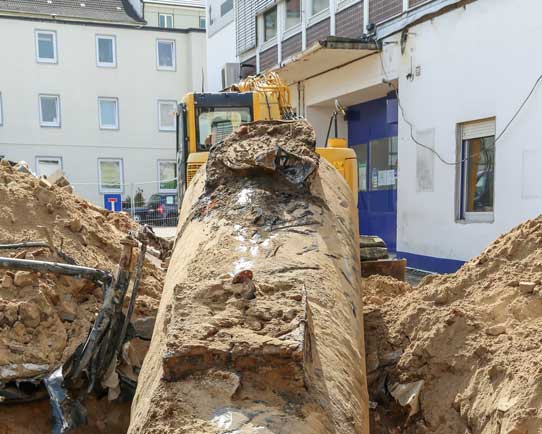
Remove oil tank: Get a free quote • Fast response
Remove oil tank
Do you have an oil tank that you want to remove? As of January 1, 2020, it became illegal to use mineral oil to heat homes and other buildings. This means that anyone with an old oil tank must remove it as soon as possible.
Removing an oil tank is no easy task, and it’s important that you get help from someone who has experience with this. We can provide you with a free, no-obligation quote from a contractor in your area.
Get a free quote for oil tank removal
Send us a short description of your wishes and needs, and we’ll help you find the best suited excavation contractor for your particular job.
Your contact information will only be used in connection with the request. Your personal data will not be disclosed to unauthorized persons.
How much does it cost to remove an oil tank?
The price of removing an oil tank depends on several things, such as the size of the tank, how easily accessible it is and the amount of contamination in the surrounding ground. It usually costs in the range of NOK 10,000 – 30,000 to remove a buried oil tank. If the tank is deep or difficult to access, the price may be higher.
If the ground around the tank is contaminated, the masses will need to be replaced, which will also increase the price. Removing an oil tank requires experience and the right equipment to be carried out safely and efficiently. That’s why it’s important to choose a contractor with previous experience.
Where should the oil tank be delivered?
The most common way to dispose of an oil tank is to deliver it to an approved collection point. An oil tank is considered hazardous waste and should not be disposed of with normal waste. To safeguard health, safety and the environment, waste reception centers that accept oil tanks often have specific requirements for how the tank should be treated before it is handed in. This may mean that the tank must undergo pre-treatment or that documentation must be provided on the condition and contents of the tank.
Most reception centers accept oil tanks free of charge as long as they are completely cleaned and cut into smaller pieces. If you’ve hired a company to take care of the work of removing the oil tank, they will usually also take the tank to an approved reception when they’ve finished the job.
When do you have to remove the oil tank?
Many municipalities have local regulations governing how to handle oil tanks that are no longer in use. If the municipality in which you live has not adopted such a regulation, section 7 of the Pollution Control Act applies. Although this section does not explicitly require the removal of oil tanks that have been taken out of use, the recommendation from the Norwegian Environment Agency is nevertheless clear: Oil tanks should be removed to avoid potential environmental problems in the future.
According to section 7 of the Pollution Control Act, the owner of an oil tank has a duty to prevent pollution and is liable if leaks occur from the tank. This means that the responsibility for removing or securing the tank lies with the tank owner. Securing the oil tank is a process that involves emptying and cleaning the tank, followed by filling it with a suitable material such as crushed stone. The tank must then be disconnected and sealed. It’s important to note, however, that refilling of oil tanks is only permitted in municipalities that have given permission for this.
Who can empty, clean and dig up or refill buried oil tanks?
Although the pollution regulations do not set formal competence requirements for those who empty, clean or remove oil tanks, it is important that the work is carried out by qualified personnel to avoid pollution. Improper handling can lead to leaks, ground contamination and damage.
Operators taking on such assignments should have sufficient expertise and experience, as they can be held liable if something goes wrong. Residual oil from the tank is considered hazardous waste and must be declared upon delivery to an approved reception facility. The Norwegian Labor Inspection Authority also has its own regulations with requirements for companies that work with tanks, relating to safety and the risk of fire and explosion.
Some parts of the work, such as digging up to the tank, can be done by the tank owner in consultation with a hired company. However, the actual emptying, cleaning and removal should be left to professionals with the necessary expertise and equipment to ensure that the job is done in a safe and responsible manner.
What materials can be used to refill the oil tank?
If the oil tank is not to be removed, but rather refilled, it is important to be aware that there are strict requirements for the materials to be used. The materials must be clean and uncontaminated. They must also be suitable for the purpose and not contain organic material such as wood residues, peat, sludge or similar. Sand and crushed stone are good examples of materials that can be used.
Such materials can be sucked out of the tank again if it becomes necessary to remove the tank at a later date. The materials should also be placed in the tank in layers and compacted well. It is important that the operator refilling the oil tank documents that approved masses have been used.
What requirements apply to oil tanks that are not buried?
Oil tanks that are not buried, but placed on a cast foundation or in a basement, are not regulated by the regulations. These tanks do not need to be removed, but they must be emptied of oil, thoroughly cleaned and secured against future use. This applies regardless of whether the tank is in use or not.
The reason tanks need to be emptied and secured is that old tanks can start to leak, posing a pollution risk. There are companies that specialize in cleaning and securing indoor oil tanks. Here, too, it is important to choose a reputable company with the right expertise, as there are specific requirements for how this should be done.
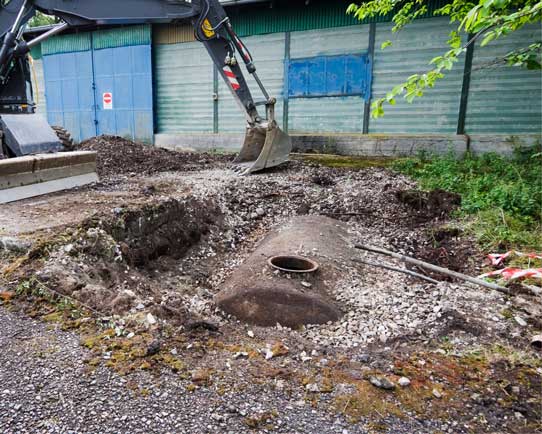
Receive a quote for oil tank removal
When choosing a contractor, it’s important to check that they have the expertise and equipment required to handle oil tanks. It may also be appropriate to look for a turnkey supplier that can empty, clean, excavate and deliver the tank to reception.
We work with experienced decontamination companies and excavation contractors across the country and can easily put you in touch with a reliable decontamination company in your area.
Fill in the form on our website with a brief description of the assignment and you will be contacted by one of our partners within a short time. Our service is completely non-binding and costs nothing.